What Is the Future of Nursing School Admissions?
Responsible AI offers nursing admissions committees a path through rising application volume and faculty shortages, but only when human judgment stays firmly in command.

Los Angeles - Earlier this month, the 2026 UCLA Nursing Science and Innovation Conference brought together nurse educators, researchers, and clinical leaders from a wide range of institutions, from UCLA to Columbia University, for a focused conversation on the future of nursing education, practice, and innovation.
For nursing leaders, the conference serves as a flagship forum for emerging ideas — the kind of setting where new models of training, workforce development, and technology-enabled practice are tested in front of the people who will ultimately shape the field.
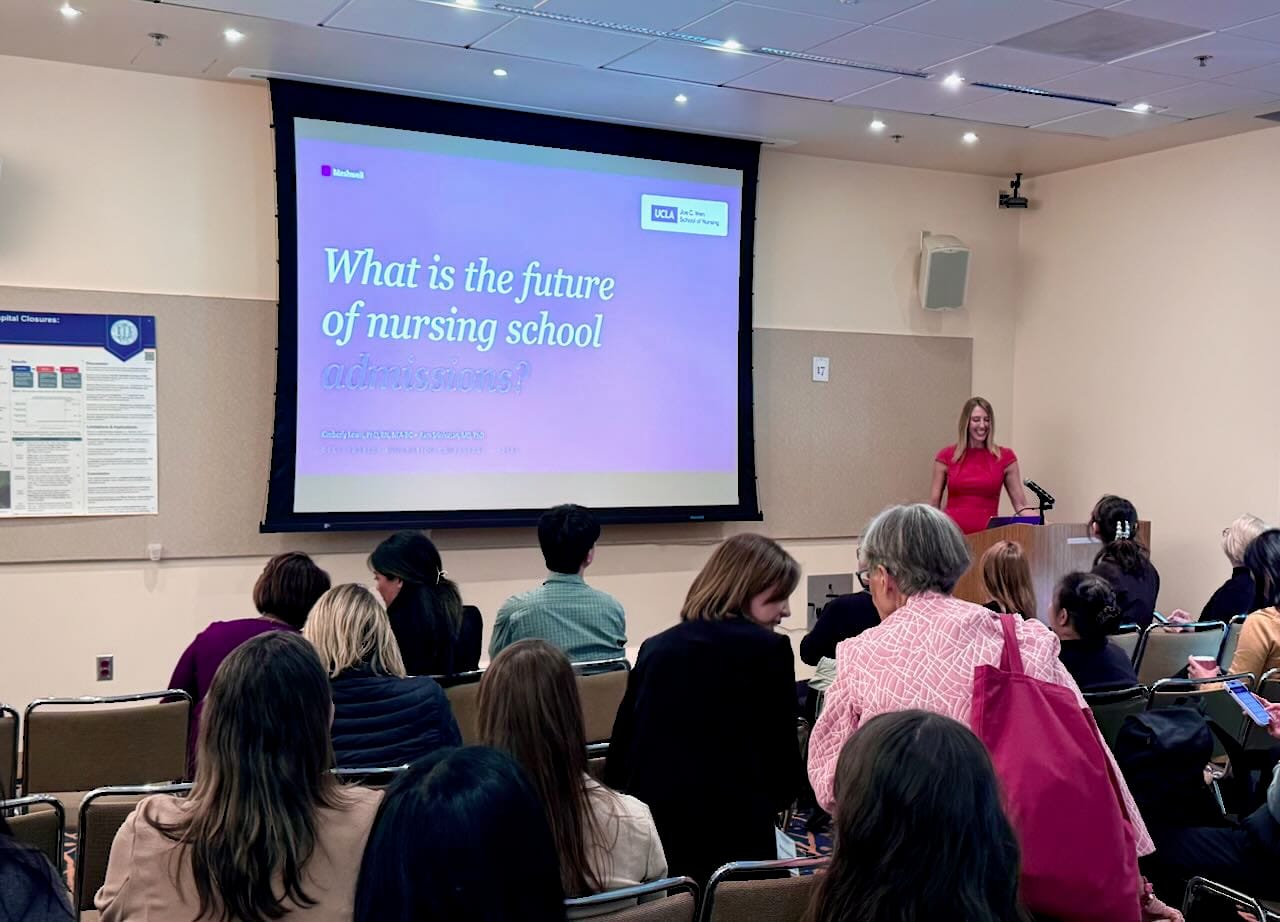
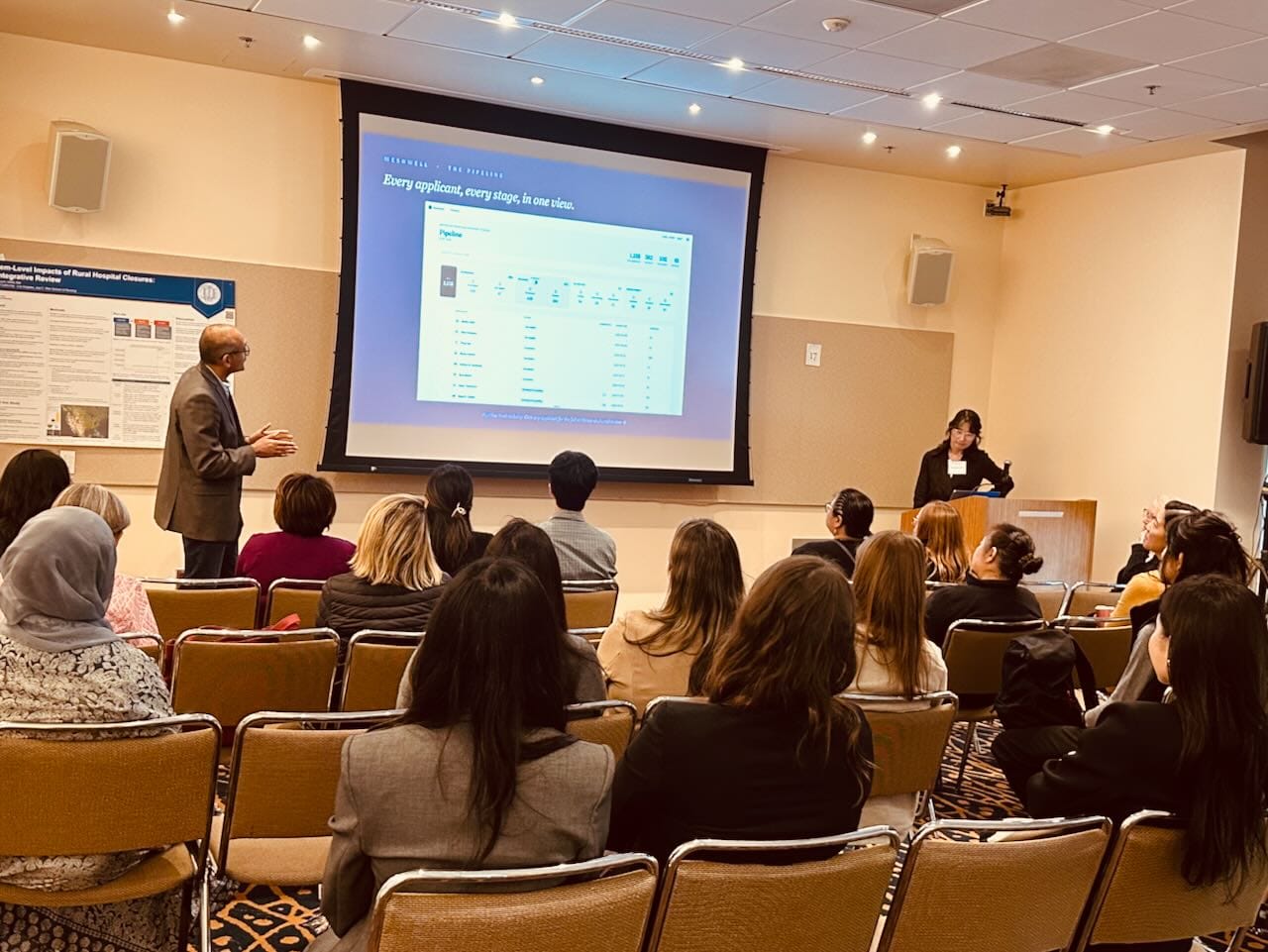
Meshwell, in collaboration with UCLA Nursing, was featured as a podium presentation at this conference with a talk titled “What is the future of nursing school admissions?”
The presentation was jointly delivered by Kimberly Lewis, PhD, RN, NEA-BC, CGNC, Assistant Adjunct Professor at the UCLA Joe C. Wen School of Nursing and Senior Nurse Scientist at UCLA Health’s Center for Nursing Excellence, and Ram Srinivasan, MD, PhD, physician-engineer and CEO of Meshwell, based in San Francisco.
The presentation also marked the early stages of a pioneering collaboration between Meshwell and UCLA Nursing, centered on a fundamental question: how can AI be deployed responsibly for the benefit of nursing school admissions committees?
For Meshwell, that question sits at the core of the company’s work in health professions admissions. The goal is not simply to “add AI” to applicant review, but to help programs build end-to-end admissions workflows that remain human-led, auditable, evidence-based, and aligned with institutional values.
The collaboration also represented a return to the UCLA ecosystem for Srinivasan, who completed residency at UCLA Radiology and, while still a resident, founded and led the Neural Signal Processing Laboratory from 2010 to 2014. In doing so, he became the first resident physician at UCLA Radiology to serve as a principal investigator leading an independent research laboratory.
That background shaped the tone of the presentation: technical optimism, but with clinical restraint. In nursing education, as in medicine, the question is not whether a technology is impressive. The question is whether it can be deployed safely, transparently, and in service of better human decisions.
The question facing nursing admissions
The question at the center of the talk was simple, but urgent:
What should nursing admissions look like one year from now, ten years from now, or twenty years from now?
The answer is not just about artificial intelligence. It is about faculty time, fairness, applicant review, compliance, and the need to build admissions systems that can scale without losing human judgment.
Nursing education is not preparing for a future capacity challenge. It is responding to one that exists now, and has persisted for at least two decades. Demand for nursing education continues to exceed what many programs can accommodate because faculty availability, clinical placements, and other educational resources have not kept pace with workforce needs. Against this faculty capacity crisis, applicant volume is rising.
Admissions is only one part of that larger system. But it is a part of the system where faculty time is consumed at enormous scale.
The admissions bottleneck is already here
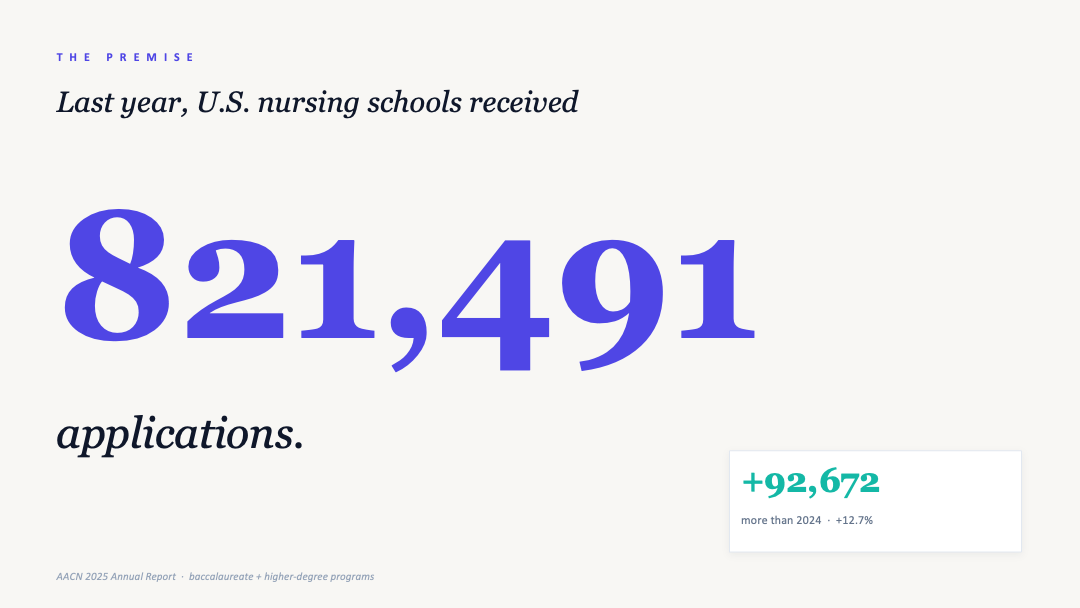
In 2025, U.S. nursing schools received 821,491 applications to baccalaureate and higher-degree programs, according to the AACN annual report. That represented an increase of more than 92,000 applications over the prior year.
At the same time, more than 93,000 qualified applicants were turned away.
Those rejections were not simply a reflection of applicant quality. They reflected the constraints nursing education now faces every year: faculty shortages, limited clinical placements, budget pressure, and the growing difficulty of reviewing large applicant pools with the same depth, care, and consistency.
From application to acceptance letter, every applicant moves through a sequence of human-mediated reviews: application submission, transcript and prerequisite verification, eligibility screening, file review, interviews, committee deliberation, and ultimately an admissions decision.
Each step depends on human judgment.
That human judgment is essential. But the workload is becoming harder to sustain.
The right question is not “Can AI make admissions decisions?”
It is tempting to frame the future of admissions around whether AI should or should not be used.
That is the wrong starting point.
The better question is:
Where can technology help faculty use their time more effectively, while preserving institutional responsibility for admissions decisions?
In health professions education, admissions is not just a sorting problem. It is a mission-alignment problem. Programs are not merely selecting students with strong grades. They are identifying future clinicians who can communicate, persist, reflect, collaborate, and serve patients and communities.
That kind of judgment cannot be outsourced to a black box.
But it can be supported by better workflow.
This is where AI may have a role — not as an autonomous decision-maker, but as part of a broader, auditable admissions system.
Why AI is being considered
There are real reasons admissions teams are beginning to explore AI-supported review.
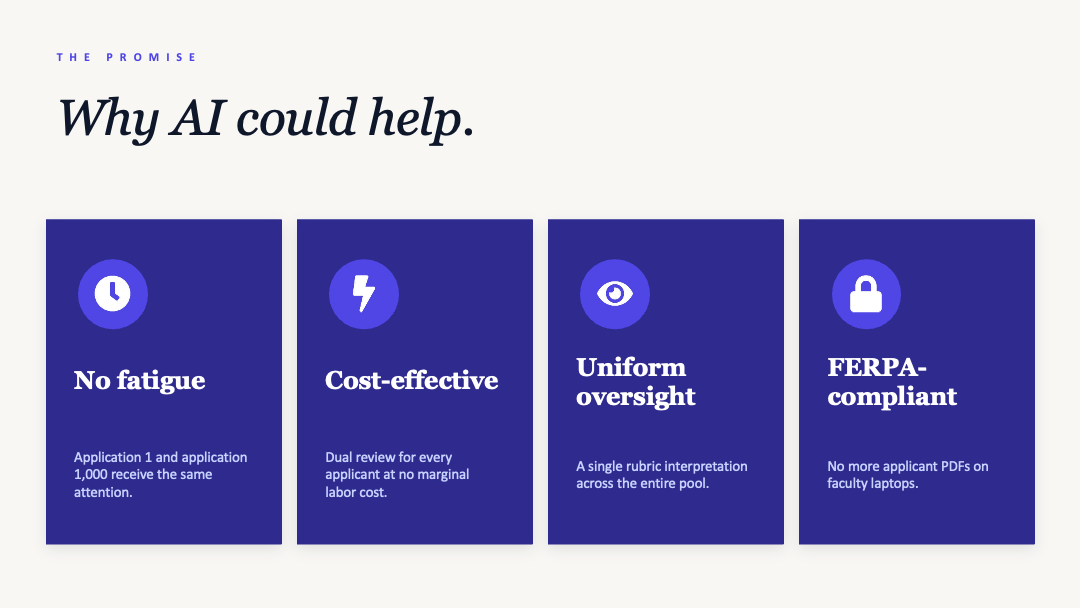
AI does not experience fatigue. The thousandth application can receive the same level of attention as the first.
AI can apply a rubric consistently across a large applicant pool.
AI can make dual review more feasible, especially when programs do not have the faculty capacity to assign every applicant to multiple human readers.
AI can also improve data containment. Instead of applicant PDFs being downloaded to personal laptops or passed around through fragmented systems, review can happen inside a controlled institutional environment.
These are meaningful advantages.
But they only matter if the system is designed responsibly.
The warnings matter
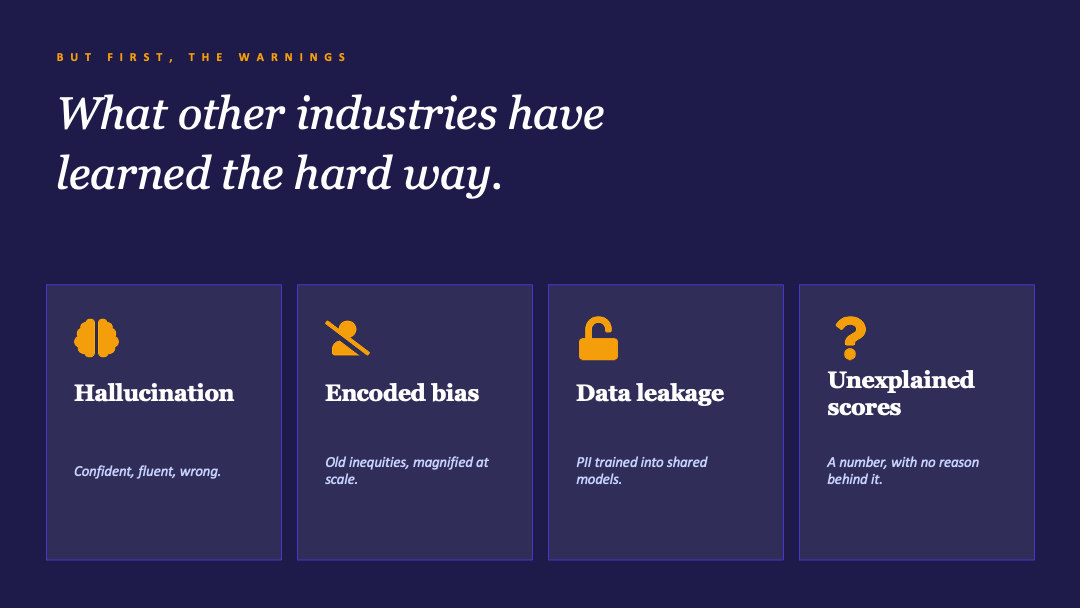
Other industries have already shown what can go wrong when AI is deployed too quickly or too casually.
Models can hallucinate. They can generate confident explanations that are fluent but wrong.
They can encode bias. Historical inequities can be reproduced and scaled if they are not actively monitored.
They can create privacy risk if personally identifiable information is handled carelessly or used inappropriately for model training.
They can produce unexplained scores that are difficult for faculty, applicants, or accreditors to understand.
None of that is acceptable in admissions.
For health professions programs, AI cannot simply be “added” to admissions. It has to be governed.
Three principles for admissions AI
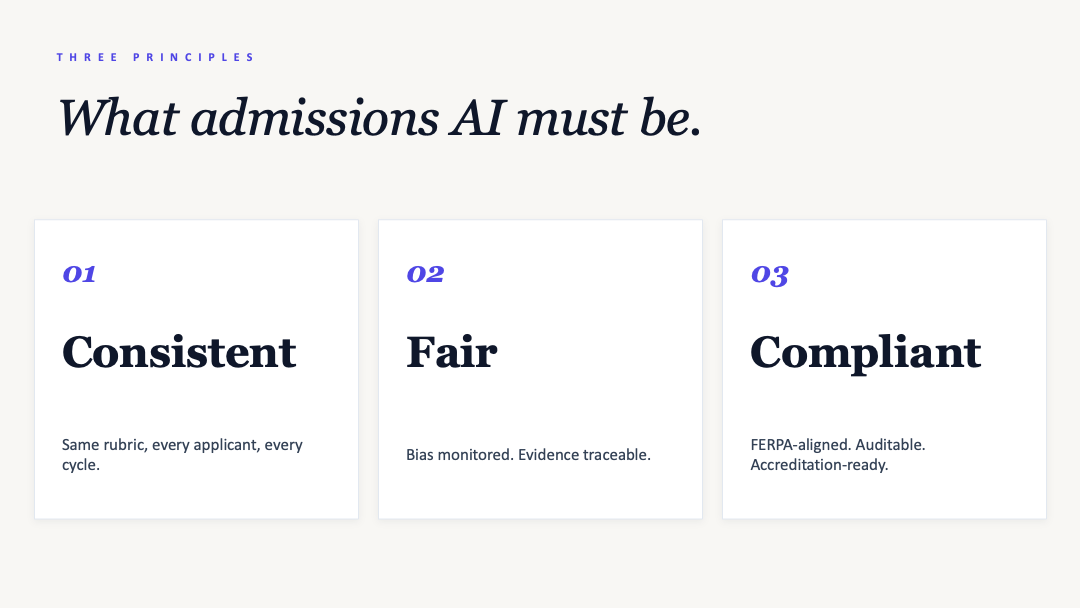
In the UCLA Nursing presentation, the core Meshwell-UCLA framework for AI in nursing school admissions was organized around three pillars:
Consistency.
The same rubric should be applied across candidates, from the beginning of the cycle to the end.
Fairness.
Bias must be monitored. Differences between human and AI scoring must be visible. Evidence should be traceable.
Compliance.
Admissions systems must be FERPA-aligned, auditable, and ready for institutional and accreditation review.
These principles are not abstract. They determine whether AI is helpful, harmful, or simply another layer of complexity.
Human review is not perfectly consistent either
One of the most important points from the presentation was that the current human process is not as consistent as many people assume.
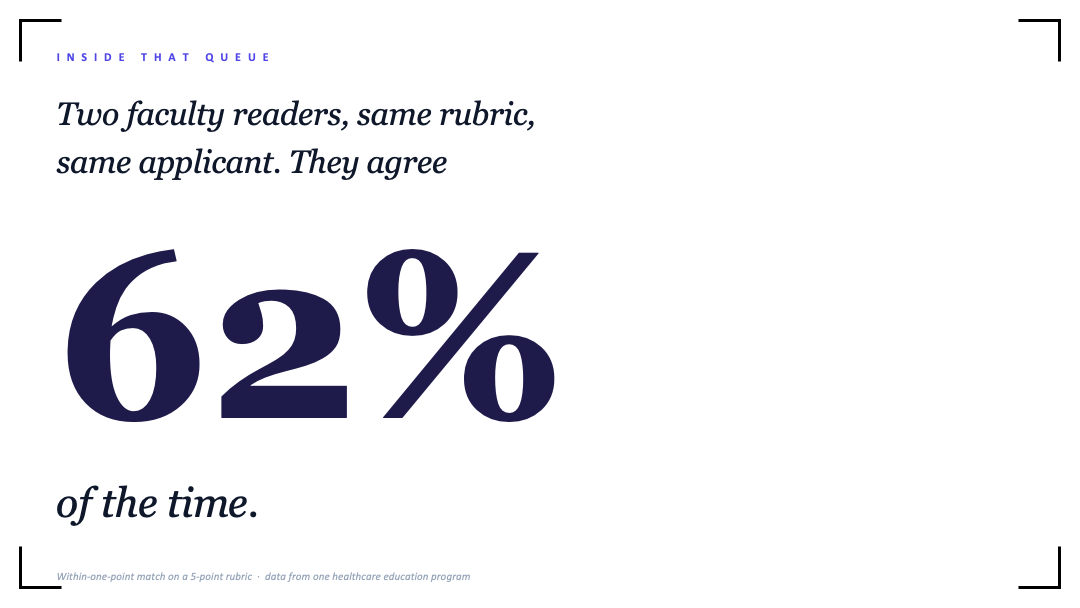
In one healthcare education program dataset reviewed by Meshwell, two faculty readers reviewing the same applicants with the same rubric agreed within one point on a five-point holistic score only 62% of the time.
That result is not a criticism of faculty.
It is a reflection of reality.
Faculty reviewers are busy. Application files are long. Rubrics require interpretation. Readers may weigh different parts of the application differently. And when programs are reviewing hundreds or thousands of applications, variability is inevitable.
The question, then, is not whether AI can replace a perfect human process.
The question is whether AI can help make an imperfect human process more consistent, transparent, and reviewable.
AI as a second reader
In the same analysis, Meshwell was trained on reviewer scores and then evaluated against held-out applicants.
The result was notable: the AI agreed with each human reader more often than the two human readers agreed with each other.
The dataset was limited and came from a single healthcare education program, so the finding should not be overgeneralized. But it suggests a practical role for AI in admissions: not replacing faculty judgment, but serving as a consistent second reader that can identify discrepancies, support calibration, and help committees understand where review variability is occurring.
That is a very different model from autonomous admissions.
It is closer to decision support.
Evidence matters more than scores
One of the most important design principles in Meshwell is that a score should never stand alone.
Every score should be connected back to the words, experiences, or evidence that produced it.
In practice, that means reviewers should be able to click a score and see the underlying passage from the application that supports it. A professionalism score, service score, resilience score, or mission-fit score should not be an unexplained number. It should be evidence-anchored.
This matters for several reasons.
It helps faculty trust, challenge, or override the AI.
It makes committee discussions more concrete.
It supports auditability.
It reduces the risk of “vibes-based” scoring, whether the score came from a human reader or a model.
The future of admissions AI should not be a spreadsheet of mysterious numbers. It should be a workflow where every judgment can be traced back to the applicant record.
The workflow is bigger than the model
A common mistake in discussions about AI is to focus only on the model.
In admissions, the model is only one component.
The broader workflow matters just as much: applicant intake, transcript review, prerequisite verification, rubric design, faculty assignment, scoring, comments, committee review, discrepancy resolution, audit logging, and final decision-making.
For nursing, PA, medical, and allied health programs, admissions is a coordinated institutional process. The goal is not simply to “use AI.” The goal is to help programs manage the full admissions workflow with more consistency, less fragmentation, and better oversight.
That is why Meshwell’s focus is not just AI scoring. It is the admissions system around the scoring: pipeline visibility, evidence-based review, secure faculty discussion, reviewer calibration, discrepancy flagging, and audit trails.
AI is one part of that system. It should not be the system.
Responsible rollout should be gradual
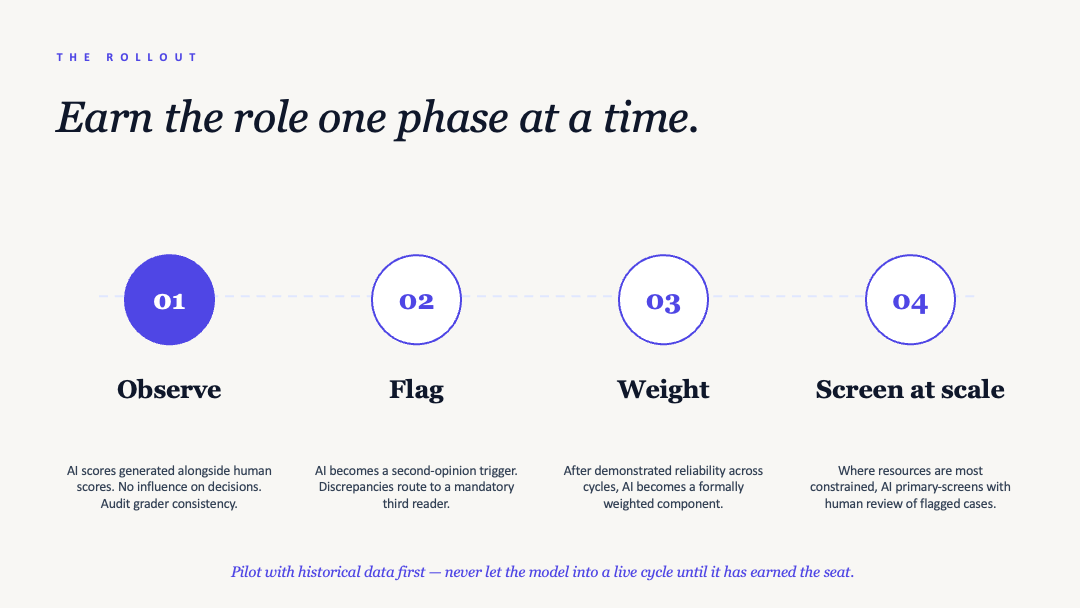
One of the clearest takeaways from the UCLA Nursing presentation was that AI should earn its role over time.
A responsible rollout might begin with historical data. The AI generates scores alongside prior human scores, but has no influence on decisions. The program studies agreement, disagreement, bias patterns, and rubric fit.
Only after that should AI enter a live admissions cycle, and even then, cautiously.
A staged approach might look like this:
First, the AI observes. It scores applications in parallel with human reviewers, without affecting decisions.
Next, the AI flags. It identifies cases where human and AI review diverge, triggering additional review.
Later, the AI may be weighted. After demonstrated reliability across cycles, AI could become a formally defined component of review.
Eventually, in highly constrained settings, AI may help screen at scale. But only with human review of flagged cases, documented governance, and clear institutional oversight.
The key principle is simple:
Do not let the model into the admissions process until it has earned the seat.
The future of admissions at nursing schools is human-led, AI-supported
The future of nursing school admissions will not be defined by whether programs “use AI.”
It will be defined by whether programs can build admissions processes that are more consistent, fair, compliant, and humane.
Faculty judgment remains central. Admissions committees remain responsible for decisions. Programs must continue to define their own missions, rubrics, and standards.
But the tools around that process need to evolve.
As applicant volumes grow and faculty capacity remains constrained, health professions programs need systems that help them review applicants carefully without overwhelming the people doing the work.
That is the opportunity for responsible AI in admissions.
Not to replace the reader.
Not to automate the committee.
Not to reduce applicants to numbers.
But to support a better review process — one where evidence is visible, discrepancies are flagged, faculty time is respected, and decisions remain accountable to the program.
For nursing education, and for health professions admissions more broadly, that is the future worth building.